
The Future is France (Part I)
The Coming Tripartite Division of European Politics

Rarely venturing into the realm of specific predictions, I nevertheless sometimes pose rethorical questions pertaining to the future. One of said rhetorical questions, which provided the title for a previous article of mine, can now clearly be answered in the affirmative. Recent political developments, most notably British local elections, have strengthened my belief that the political conflict in Western Europe is likely to take the shape which has defined French politics for the past decade. Though others might disagree, I feel rather confident in predicting that this political conflict is extremely likely to be defined by a three-way division. This shape is not yet visible everywhere, as politics in the two other large democracies of Western Europe (Germany and the UK) is defined by five rather than three political forces. Yet if current trendlines continue, the French setup is likely to come to dominate the two Germanic nations as well. By retracing the history of the political conflict in the modern era, this articles seeks to explain why a tripartite division of the political conflict is likely to be inevitable, which political forces are likely to dominate, and what this means for those political forces uncomfortable with the current rise of the nationalist right.
Brahmins and Merchants
The recent UK local elections were widely interpreted as marking the end of the two-party duopoly of Labour and the Conservatives. The governing Labour Party losing more than 1500 councilor seats would not have marked a drastic shift in and of itself, but what defined the elections as a true ceasura was the fact that this loss did not benefit the main opposition, the Conservatives, which itself lost more than 500 councilor seats. The losses of the two established parties were the inverse of gains made by Reform UK, the Greens, and the Liberal Democrats. Thus a political system which was traditionally defined by the rivalry of Labour and the Tories has become distinctly multipolar, with five political parties each able to garner the support of significant segments of the population (though none are able to unite a coalition as large as that fielded by the two major parties in their heyday).
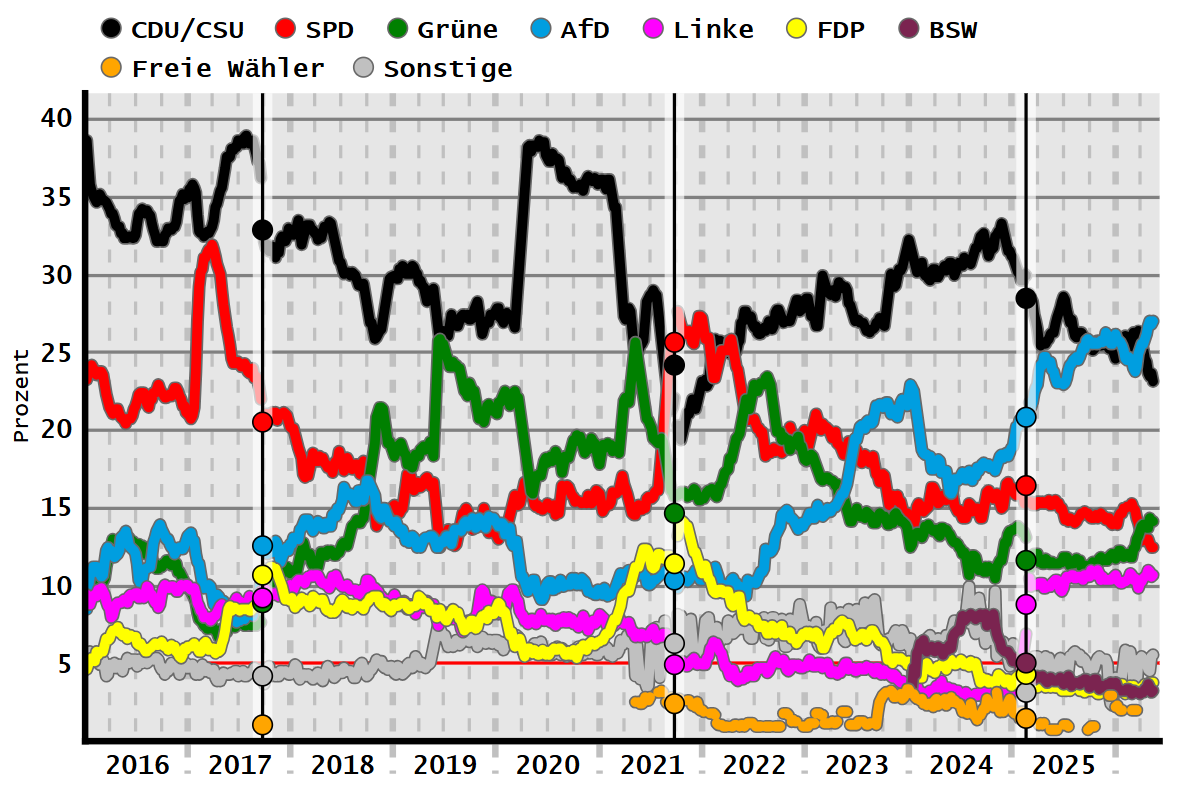
What’s striking about this five-way division is how closely it resembles the current political setup in Germany. Five political parties are currently represented in the Bundestag, with a political conflict once dominated by two major “Volksparteien” (CDU/CSU on the right and the SPD on the left) having settled into a multipolar setup. Just as in the United Kingdom, the two former “Volksparteien” have seen their dominance eroded in recent years (with the SPD being the first of these two not able to become either the largest or second-largest force in the Bundestag in the 2025 election), making room for their newer challengers. Also notable is that these newer challengers are structurally similar in both countries. Just as in the UK, the main beneficiary from the loss of support of the previously dominant parties has been a party of the populist right, the AFD being the German the pendant to Reform UK (though the AFD is considerably more radical and philosophically different in some notable regards). And just as in the UK, the two forces capitalizing on the SPD’s misfortune follow a similar script, one of them tending to garner support from left-wing students and the urban working classes (Die Linke, the Greens) while the other primarily draws support from economically secure college graduates (Bündnis 90/Die Grünen, Liberal Democrats). The collapse of the two established political forces yields structurally similar developments in both countries.
At this point it seems that a five-way division is going to define the political conflict for the foreseable future. Yet, to circle back to the title, developments in the third major democracy of Western Europe dispute this. Always part of the political avant-garde, France once more seems to foreshadow the politics of the rest of the Continent. There the political conflict has settled into a three-way division, defined by a party of the populist right (National Rally, previously National Front), a centrist liberal force (Renaissance, previously En Marche) surrounding President Emmanuel Macron, and a broad left-wing alliance (La France Insoumise/NUPES). In France the two major political factions which defined the Fifth Republic thus far (Gaullist Right and Socialist Left) have not just lost dominance but ceased to be relevant altogether.
Thus it seems quite likely that the process of transformation of the political conflict is simply further along in France than in the other two countries, and that the erosion of support for the traditional left and right has simply not proceeded as far in the UK and Germany as it has in there. The current five-way division thus includes two equally moribund broad factions:
Traditional Left: SPD, Labour, formerly French Socialist
Traditional Right: CDU/CSU, Tories, formerly Gaullists
Their likely disappearance eventually giving way to three factions dominating the future political conflict:
Nationalist–Populist Right: AFD, Reform UK, Rassemblement National
Centrist Liberalism: Bündnis 90/Die Grünen, Liberal Democrats, Renaissance
Left-Wing Populism: Die Linke, the Greens, La France Insoumise
(The German and British Greens being grouped in different categories is largely caused by the structural differences between the Labour Party and SPD, the former having massively drawn support from well-off professionals and college graduates while the latter remains largely a party of the traditional working classes. Thus the Greens in Germany managed to draw support from a relatively wealthier milieu than their British counterparts, leading to a distinct classification.)
Remembrance of Politics Past
Another argument in favour of the tripartite division of the political conflict as the new norm is that it closely resembles a much older status quo preceding the development of the great people’s parties of the twentieth century. The left-right division that has defined politics for the past seventy years represents a specific set of twentieth-century circumstances, most notably a high degree of class polarization. Prior to this political conflict, the simple left-right dichotomy (with “left” here representing socialist or social-democratic forces) did not exist, conservatives coexisting with both liberals and, somewhat later, socialists. What is notable about this period is that, similarly to the present, it can be defined as a “multi-elite” system. Rather than politics being neatly divided between bottom and top, distinct factions of the wealthy and powerful fought one another while garnering support from different segments of the downtrodden at various moments. This setup primarily crystallized as the old feudal aristocracy was replaced by the bourgeoisie, which felt that it lacked political representation commensurate with its economic weight. This struggle took various forms in different countries.
In France, the growing middle classes’ desire for political representation led to a violent overthrow of the established ancien régime, with the French Revolution later characterized by thinkers such as Karl Marx as the bourgeois revolution. Enmity toward feudal elites was so great that it produced an alliance between the classes that would later morph into the (in the Marxian view) profoundly opposed industrial bourgeoisie and proletariat. The Jacobins (later Montagnards), largely composed of lawyers and the educated middle classes, allied with the sans-culottes — downtrodden urban workers and petty producers — to push for a radical break with the established order. This alliance was essential in the radicalization of the early revolution, eventually leading to the abolition of the monarchy and the advent of the Reign of Terror. The violent destruction of the old order laid the groundwork for the bourgeois state, which came to dominate Europe throughout the nineteenth century, many elements of the revolution having been exported by Napoleon Bonaparte.
This bourgeois state was also inspired by developments in a country that saw its class conflict resolved in a much less violent way: the United Kingdom. Here the growing industrial bourgeoisie did not violently overthrow the aristocratic elites, instead allying with them during the Revolutionary and Napoleonic Wars. The threat French expansionism posed to British imperial and business interests was large enough to produce this early version of a “Burgfrieden.” Yet as the threat of French dominance over the continent receded, the rising classes sought political concessions in the United Kingdom too. I have already discussed these attempts in my previous series on the history of the Conservative Party, but here it will suffice to say that the British governing classes managed to oversee the shift of power from landed gentry to industrialists while allowing all elites to retain a stake in the fate of the country. Peelism and later Disraelian Conservatism allowed the landed gentry to cautiously embrace the reforms necessary for their continued existence without blocking necessary changes. The rise of the British bourgeoisie thus proceeded in a significantly less disruptive and violent fashion, eventually yielding a relatively stable rivalry between the Conservatives and Liberals. This rivalry saw both factions court the downtrodden workers, the proletariat variously allying with the bourgeoisie and aristocracy.
Over time, however, a clearer political tripartition can be observed. After the replacement of the feudal order was accomplished, the working class and the political left (in the contemporary sense of the word) increasingly began to act as an independent political force. As the urban industrial working classes continued to grow, so too did what might be termed “class consciousness.” The decisive turning point in crystallizing this new structure of political conflict was once more a revolution in France. The restored Bourbon monarchy had fallen in 1830, giving way to the more liberal July Monarchy. This monarchy itself fell in another revolution in 1848. Once more an alliance had formed between the bourgeoisie and the working classes, and once more an established monarchy was swept aside. Yet this time the alliance did not last long, as divisions over how the second attempt at republican government in France should be structured soon produced a bloody clash. Liberals and radical republicans descended into bitter enmity as the latter began to demand a democratic and social republic (république démocratique et sociale). They were spurred on in this hope by the establishment of a series of National Workshops, which provided work for the unemployed. The republican government’s desire to close these workshops provided the impetus for the June Days uprising, possibly the first uniquely proletarian attempt at revolution. The uprising was eventually crushed, the very class that had just been allied with the workers now turning on them to establish a bourgeois republic while ignoring the social demands previously advanced. The suppression of the uprising laid the groundwork for the subsequent enmity between the classes whose opposition would eventually lead to the final revolution Marx would soon come to envision.
From this point onward, Western politics entered into a relatively formal and stable tripartite division. The development of leftist and working-class politics proceeded at different speeds in different countries, but the general trend appeared in almost every Western nation. Workers everywhere began to dream of another, even more historic and final revolution, as Marx had predicted. This vision succeeded in attracting millions of workers and citizens, though it would take considerable time before this political influence actually shaped policy. Prior to World War I, among the major nations of Western Europe only Imperial Germany saw the beginnings of a developed welfare state. Dismayed at the growth of social democracy, Otto von Bismarck sought to dent the movement’s momentum by agreeing to a series of reforms implementing many of its demands, while at the same time continuing his attempts to suppress it. In Britain and France, supporters of such measures would have to wait much longer. The Labour Party and the French Section of the Workers’ International had become relevant political forces, but they were still unable to seize power on their own. The extremely unequal social and economic structures of the major Western nations remained sustainable, the benefits of their economic dynamism and large colonial empires proving sufficient to stave off revolution despite extreme inequality.
The Polarization of the Twentieth Century
The final breakthrough of working-class leftism, as well as the massive reduction in economic inequality, was only brought about by the great catastrophes of the early twentieth century. World War I destroyed the previous structure of the global economy and swept the world’s first communist regime to power. From this point onward, the threat of socialist revolution never left the minds of Western elites. Concern grew even further as the Great Depression completely undermined belief in the virtues of laissez-faire capitalism. From this point onward, even the most traditionally liberal countries had to make concessions to demands for statist intervention and redistribution. Even political forces that nominally remained attached to liberalism, such as the Democratic Party in the United States, introduced significant elements of social democracy into their political programmes. In continental Europe the shift proved even more radical, as socialist parties began to come to power in many major democracies. The Labour Party first provided a Prime Minister in 1924, though Ramsay MacDonald failed to implement the core demands of the party and was eventually expelled from the organization over forming a national government. The Popular Front implemented the beginnings of the French welfare state in 1936, and the social democrats could build on the foundations of Bismarck’s welfare state during the years of the Weimar Republic. The three-way division was no longer sustainable, with liberalism (in the European sense) no longer able to remain a dominant force on its own. This growing bipolarization became completely entrenched in the years following World War II, Western politics dividing into two camps just as the entire world did. In this setup, the liberals who had once formed an independent political bloc had to pick a side. The previous liberal coalition fractured, as industrialists and financiers sided with the right while socially liberal professionals sided with the political left. Professionals and highly educated voters without clear social orientations remained divided, siding with one camp or the other at different points.
This bipolar split, which defined the entirety of the post-war and Cold War era, was the heyday of the people’s parties (Volksparteien), which increasingly developed into “catch-all parties.” Rather than merely representing one social class, the left and the right contained broad coalitions composed of frequently distinct segments of society. Those contained within these “big tent” parties often had little in common except for one decisive factor. The right and the left clearly represented “up” and “down” respectively. The right represented those with high social status and therefore a strong desire to preserve existing arrangements, while the left represented those with lower social status and thus a desire to see things change. This bifurcation in many ways favoured those on the lower end of the social spectrum. By uniting all those disfavoured by the system, the political left had built an incredibly effective vehicle for egalitarianism. This era contained the longest sustained period of broadly shared economic growth, as redistributive taxation, strong unions, and regulations on corporate power allowed for the development of a large industrial middle class, as well as advances in women’s rights, the end of colonial empires, and the long-desired suspension of legal discrimination against ethnic minorities, especially in the United States. By polarizing political conflict along class lines, the left managed to turn many of its long-desired goals into reality.
Yet eventually this setup too came to an end. At first, however, it seemed as though it was intensifying. The sustained crisis of the post-war consensus, especially apparent following the oil shocks of the 1970s, led to a durable shift on the political right. I have already covered the rise of Ronald Reagan and Margaret Thatcher multiple times before and will therefore focus here only on one of its consequences: its ability to build an effective coalition of all those with elevated social status. In the Anglosphere this period saw an increase in class polarization, but what made it notable was that, despite this focus on the upper classes, these figures managed to build incredibly dominant political coalitions. Especially noteworthy was the fact that the educated professional classes, which had become a much more important constituency due to the broad expansion of higher education, shifted toward the political right. The combination of business interests, yuppies, and traditional social conservatives meant that the working class found itself largely bereft of allies. In Continental Europe this development did not proceed quite as dramatically, as Conservatives there largely refused to go along with the most radical reforms Reagan and Thatcher implemented. Neoliberalism did not come to the Old Continent in one massive wave, but over time it too would slowly chip away at Europe’s established political structure.
The sustained dominance of these new “neoliberal” conservatives convinced leaders of the political left that a dramatic strategic adjustment was necessary. Rather than relying primarily on the working class, leaders such as Bill Clinton and Tony Blair decided to aggressively court the educated and professional classes. This manoeuvre proved politically successful, as both figures soon came to dominate their countries’ politics. It did, however, herald the beginning of the end of the bipolar political system for a simple reason: it began to decrease class polarization. From this point onward, the predictive power of income on voting behaviour began to decline, a development that would eventually doom the entirety of the post-war political system.
Continued in Part II
The 1923 UK election had the third place party (the liberals after Lloyd George and Asquith stopped fighting) get 29.7% of the vote and over 25% of the seats. I don't know if we'll ever see a three way election that close. France has the two round format which consolidates a bit more but Les Republicans still get a non zero number of seats.