
Coming Apart (Part VI)
The Rift

Part I: The Transatlantic Rift and the Divergent Social Structure of the US and Europe
Part II: Divergent Paths
Part III: Opposites Attract
Part IV: The Late Consensus
Part V: Papering Over the Cracks
The year 2016 saw the issues which had been accumulating in the Transatlantic relationship for decades, finally come to the forefront. Despite the dysfunction building over the course of decades, it’s eventuall consequences still shocked the Western political establishment. Notably right wing populism did not break through in any of the Continental European countries it had been building in for decades, but rather in the Anglosphere, which had previously been relativly imune to this kind of politics. The twin shocks of Brexit and the election of Donald Trump innaugurated a new era of Western politics, and marked the beginning of the end of the Transatlantic relationship. From this point onward the two societies interest could no longer be reconciled.
Managing the Shock
The rise of right wing populism in the Anglosphere marked the beginning of the end to the Transatlantic relationship, because it meant that Europe and the Anglosphere would have contradictory interests from this point onward. When the economic structure of the two worlds had begun to diverge in the early 1980s, this had not immediatly hurt cooperation, because the two remained complemantary. The Anglosphere embraced the tertiary sector and deindustrialisation, meaning that demand for exported goods from Europe and Japan (and later developing countries such as China) remained strong. But by 2016, support for an economic modell based almost entirely on the service sector had almost completly been eroded. In the Anglosphere, political demands for a shift towards reindustrialisation was beginning to grow. Brexit and Donald Trump had shocked the establishment, almost entirely based on their support in deindustrialised regions. The surge in support in these regions had allowed the Populists to upset the established system and deliver an unexpected victory. Thus the interests of this segment of the population were crucial to ensuring right wing populisms sustained relevance.
This meant that economic policy would begin to shift away from an unrestrained embrace of globalisation, and back towards a more protectionist modell. This sparked an almost immediate negative response from those countries which had optimised their industrial strategy for the era of globalisation. Germany and Continental Europe were especially shocked, as the nations in this region had completly surrender large elements of their economic sovereignty to supranational institutions. The world Trump and likeminded figures were seeking to build, was completly anatheman to the one these countries had worked so hard to optimise for. Thus the Presidency of Donald Trump was uniquely consequential for the rest of the developed world, as he sought to undo the core tenets of the system these countries relied on.
At first many politicians bet that Trump’s wrath would primarily be directed towards China. The nation was both a major reason for the United States rapid deindustrialisation and a rising geopolitical adversary of the US. Thus politicians leading some of the major traditional allies of the US believed that the wrath of the US President would primarily be directed toward that country. At first this belief seemed to be borne out by reality. From 2018 onward the US President, began to levy a series of tarrifs based on his administrations interpretation of the Trade Act of 1974, on China innaugurating a massive trade war. China retaliated, by levying tarrifs on US goods, targeting these measures specifically so that they hurt states supportive of the President. The two nations traded blows over the course of the next 3 years, before finally settling the dispute with a bilateral trade agreement in 2020, the trade war officially paused from that point onward.
US trade policy was not just shifting with regards to China however. Under Trumps leadership, the country shifted away from multilateral and towards bilateral trade agreements. The most prominent shift in this direction, was the Presidents suspension and subsequent “renegotiation” of NAFTA, the North American Free Trade agreement implemented during the Clinton administration. This eventually led to the implementation of the USMCA, a revamped North American Trade Agreement, supposedly more tailored to US interests (though often believed to be broadly similar to NAFTA). The philosophical shift in trade policy during the Trump administration remained somewhat limited in it’s actual consequences. This also was the case with regards to Europe; the Continent was targeted through a series of steel and aluminium tarrifs levied in 2018, concurrently with those levied on China. Akin to that country, the EU immediatly retaliated, quickly implementing tarrifs on US goods such as motorcycles and alcoholic beverages. The spat meant that the relationship turned much more antagonistic and contentious during this period, but it did not yet lead to a complete collapse of trade ties. Compared with China, the attempts to rebalance EU trade remained much more targeted and narrow. For the moment the actions of the first Trump administration seemed survivable and manageble for Europe.
This sense that the new challenges could be managed, also extended to Brexit. While producing an immediate shock, the result was soon seen as a freak aberation by policymakers in Brussels. This assessment was soon backed up by the complete failure of the British political system to effectivly deliver on the electorates demands. The Brexit negotiations were led by figures previously entirely opposed to exit, with Theresa May having replaced fellow “Remainer” David Cameron in 2016. The British political system was soon plunged into a sustained crisis, as the loss of the governments parliamentary majority following the 2017 general election left it incapable of delivering on a deal for exit. Eventually Theresa May too had to exit the Premiership in a humiliating fashion, with Boris Johnson becoming the individual finally able to deliver on Brexit. Nevertheless the entire ordeal was deemed humiliating enough for the United Kingdom to where it was believed to deter future countries from exiting. As lukewarm as support for the EU had become, it still seemed more risky to leave than to remain for almost every country on the Continent.
The years immediatly following the twin shocks of Brexit and Donald Trumps election, seemed to reinforce the belief that the “populist moment” was a passing fad which could be managed by competent establishment politicians. The incompetence and lack of organisational capacity of Populist politicians made it seem that the old system could be sustained. Yet this neglected the deep structural shifts which had occured, and to which degree they had made the previous system unfeasible. Europe’s industry focused modell could not work in a world where it’s most important trade partner, began to heavily desire reindustrialisation and a reduction of persistent trade deficits. This also coincided with geopolitical shifts, which meant that the US no longer needed it’s European allies in the way that it once had. Both of these facts were illustrated two years after Donald Trump’s electoral loss in the 2020 Presidential election. In February of 2022, Vladimir Putin escalated the Russo - Ukrainian war, thus rendering the economic relationship between Russia and Western Europe completly unsustainable. Suddenly globalisation was revealed to be outdated completly independently of the demands of Westenr populists. Most notably this crisis meant that now deindustrialisation was spreading even to those parts of Europe which had previously most effectivly held on to their industrial economic modell. Most notably Germany now began to see it’s industrial dominance erode, the country at the heart of Europe suddenly plunged into sustained economic stagnation persisting to the present day.
The Return of the King
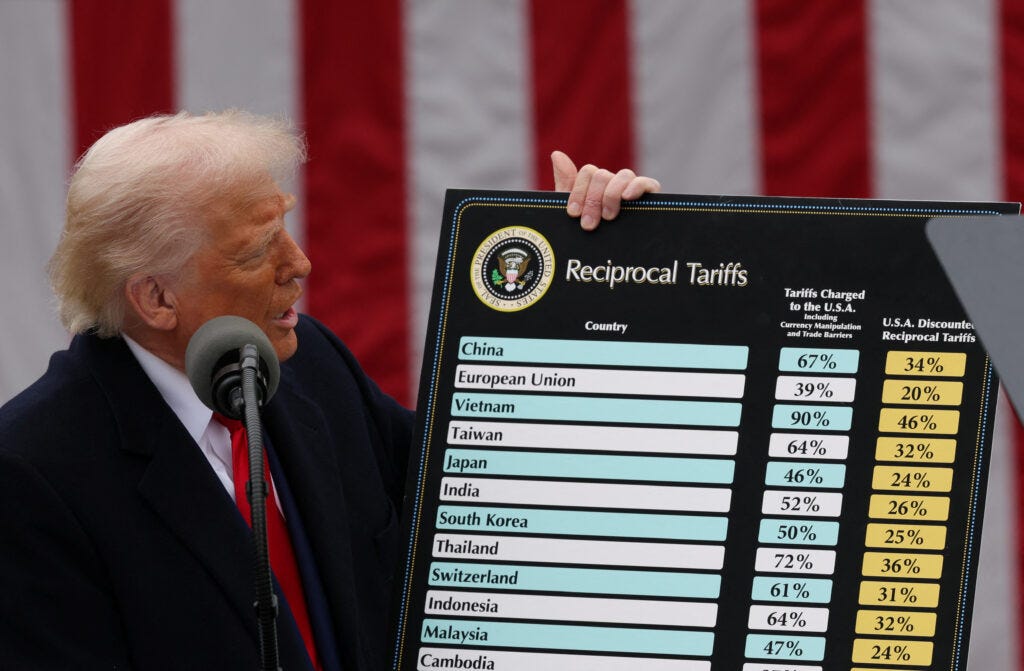
This shift also meant that when Donald Trump returned to the American Presidency in 2024, his ability to sever the relationship between the US and the Old Continent was greatly increased. This time around his attempts to shift the functioning of international trade, occured at a much more extensive scale, Europe especially subjected to much harsher tarrif measures. On “Liberation Day”, the President levied tarrifs on essentially every country with which the US had a trade deficit, marking the most extreme policy challenge to globalisation of the present era. Unfortunatly for European policymakers, the Old Continent’s ability to effectivly respond to such an onslaught had been broadly eroded by the Russo Ukrainian war. Thus European policymakers were now forced to accept a humiliating trade deal with the United States, the Agreement on Reciprocal, Fair, and Balanced Trade, which was announced on August 21st 2025 likened to the unequal treaties forced onto China more than a century earlier.
The fundamental belief by some policymakers that the Old Transatlantic relationship could ever be restored, had proved a complete illusion. The systemic incentives which had kept the two sides of the Atlantic together for the past 70 years had now dissapeared. Europe and the US were now neither similar, nor complementary. The political demands of right populism, proved to be the final nail in the coffin of this alliance, creating political incentives which were completly contradictory. With the pillars of collaboration completly eroded, a collapse is now almost inevitable, the only question remaining how precisly it will occur.
Continued in Part VII