
Coming Apart (Part V)
Papering Over the Cracks

Part I: The Transatlantic Rift and the Divergent Social Structure of the US and Europe
Part II: Divergent Paths
Part III: Opposites Attract
Part IV: The Late Consensus
The 2008 financial crisis ended the era of Western politics defined by broadly shared trust in the established system. After the failures which had led to the American invasion of Iraq, this second crisis of the 2000s revealed that economic policymakers were just as inept as the figures determining Western foreign policy. Yet, paradoxically, a crisis which had originated in the US would hurt the rest of the developed world much more severely. The crisis of financialised neoliberalism would devastate the Old Continent, which retained a comparatively more traditional economic model, while the US itself recovered relatively quickly. From this point onward, the relationship between the two continents would be rendered completely dysfunctional, even as policymakers in the immediate aftermath of the crisis attempted to restore amity. Yet this attempt was built on sand, as the eventual populist response to the crisis meant that the two societies would increasingly be pushed not just towards divergence, but outright enmity.
Distinct Recoveries
For a short period, the 2008 financial crisis was believed to illustrate the superiority of European economic policy, as “Anglo-Saxon hyperliberalism” had been proved inferior to the more managed capitalism of the Continent. Yet this sentiment was soon revealed to be a complete illusion. The crisis would lay bare the fundamentally flawed structure of the Eurozone, as the monetary union was revealed to be based on a set of narrow, and now completely outdated, assumptions. The independence of the ECB meant that individual member states were completely at the mercy of financial markets, severely limiting their room for manoeuvre when dealing with the crisis.
This strongly contrasted with the situation in the United States, in which the Federal Reserve, after having completely failed to anticipate the crisis, nevertheless managed to intervene quickly to stabilise markets. The most notable policy in this regard was the implementation of quantitative easing, a policy in which the central bank massively created liquidity to purchase government debt, mortgage-backed securities, and corporate bonds. Along with TARP (Troubled Asset Relief Program), a federal government program in which the US government deliberately purchased toxic assets, and the American Recovery and Reinvestment Act (ARRA), a fiscal stimulus passed during the first year of the Obama administration, these programs managed to end the collapse of financial markets and economic activity relatively quickly. The downside of these programs was that they largely allowed the very institutions which had caused the crisis to escape from the collapse relatively unfazed, and massively pushed up economic inequality in the years to come. Asset holders massively benefited from the program, as equity valuations skyrocketed in the wake of the crisis, while those at the lower end of the income distribution continued to suffer in the new economy.
Yet Continental Europe did not even have the privilege of such an uneven recovery. While the Federal Reserve and the federal government implemented one of the largest stimulus packages in human history, many European governments had to massively curtail spending. Unlike in the US, in which fiscal and monetary policy were made at the federal level, in Europe the ECB operated independently from national governments. To make matters worse, under the leadership of Jean-Claude Trichet, the ECB increased interest rates at the height of the crisis, implementing two rate hikes in 2011, as some nations on the Continent were plunging into the worst crisis since the Great Depression (with the contraction in economic activity more pronounced than the Great Depression in the worst affected countries). This meant that national governments were completely helpless as interest rates on government bonds skyrocketed. Countries such as Greece, Portugal, and Spain saw their interest rate differentials with German Bunds explode from early 2010 onward.
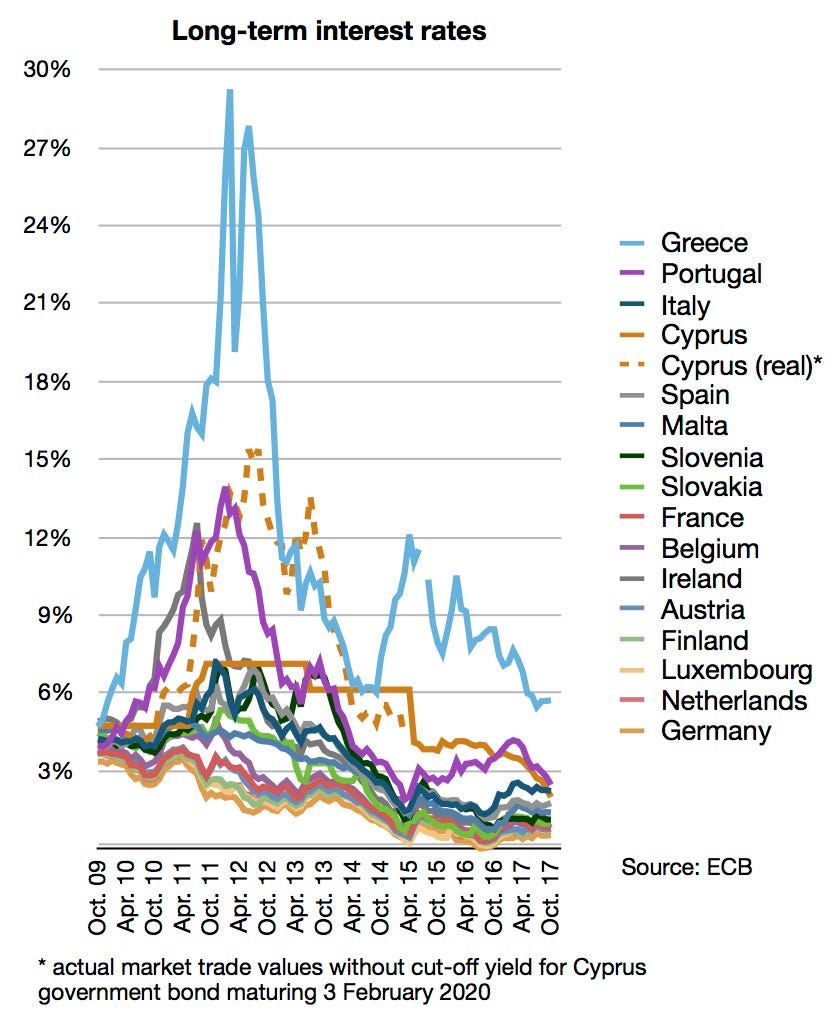
By this point, peripheral countries such as Greece had almost completely lost their economic sovereignty. The only way to get a hold of the crisis would have been for the entire currency union to issue joint debt to stimulate the Continent’s economy, establishing some form of fiscal union. Yet central and Northern countries, most notably Germany, remained sceptical of such a move. The fear that German savers would be expropriated to bail out supposedly “lazy and workshy” southerners meant that Chancellor Angela Merkel was hesitant to embrace any measure which could be interpreted as a bailout with no strings attached. The political establishment of the Continent continued to resist a breakup of the currency union, deeming that a bankruptcy of a member state had to be avoided. Thus the “Troika”, a combination of the ECB, European Commission, and International Monetary Fund, created a series of bailout programs to rescue Greece, the country at the most immediate risk of default. Yet these rescue packages came with stringent demands attached, as austerity measures were meant to assure that Greek citizens would have to adopt the mentality of the “Swabian housewife”. As a consequence, citizens of the country were plunged into crushing poverty, with unemployment peaking at more than 27%.
Hollow Emperors
Despite the catastrophic consequences of the crisis, policymakers on both sides of the Atlantic remained convinced that they could restore faith in the system and the transatlantic relationship. The two defining political figures of this period, American President Barack Obama and German Chancellor Angela Merkel, both stressed their managerialist bona fides, seeming to believe that technocratic management could preserve the economic structure. Both also repeatedly stressed their strong relationship and trust in one another, a noted contrast with the poisonous relationship between the Old World and the New which had defined the Bush administration. The two leaders managed to retain popularity, even as faith in the political system continued to erode. This false sense of stability was reinforced by the two leaders’ ability to keep political challenges in check. The “Tea Party” wave, which robbed the Obama administration of its congressional majority following the 2010 midterm elections, led to a series of federal shutdowns, but soon discredited itself with its radical demands for (extremely unpopular) spending cuts. The Syriza government, a left-wing populist force which had come to power in the beleaguered country in 2015, at first seemed determined to reject further austerity measures, but was soon cowed by the Troika and German Finance Minister Wolfgang Schäuble. Populist anger continued to rise on both sides of the Atlantic, yet no political force managed to truly gain a major foothold. In Continental Europe, far-right political forces saw a major increase in support, but the cordon sanitaire which cut them off from political power remained intact. In the US, Occupy Wall Street, a protest movement which sprang up in 2011, demanded a change to the country’s corporate culture but would eventually peter out. Yet from 2015 onward, a new form of challenge to the established system would arise, one which would completely catch the political establishment off guard. A form of right-wing populism long present on the margins of European politics would suddenly upset the politics of the Anglosphere. And this movement’s demands would finally reveal how profoundly incompatible the US and Europe had become, as political demands would now come to drive the two continents apart.
Continued in Part VI