
Coming Apart (Part IV)
The Late Consensus

Part I: The Transatlantic Rift and the Divergent Social Structure of the US and Europe
Part II: Divergent Paths
Part III: Opposites Attract
The liberal triumphalism which had defined the 1990s had allowed Europe and the United States to maintain their alliance, despite the increasingly apparent gulf in social structures between the two sides of the Atlantic. Yet over the course of the next decade the sources of this continued optimism and certainty began to vanish. A series of crises provoked a questioning of the core tenets underlying the globalised world which would have been unthinkable just a decade earlier. Eventually this shift would come to undo the Transatlantic relationship, as the attempt of the two sides of the Atlantic to deal with this fact rendered their future paths incompatible.
Inside Jobs
My previous examinations of the Transatlantic relationship dealt with the political estrangement which occurred during this period, primarily caused by the excesses of the War on Terror. The American decision to invade the country of Iraq, which was not connected to the September 11 attacks in any way whatsoever, tarnished the hegemon’s reputation. The negative effect was especially pronounced in some Western European countries traditionally allied with the United States. Germany and France both refused to participate in the invasion, their caution and concern eventually vindicated as Iraq descended into a lengthy and chaotic insurgency following the invasion. Eventually an acknowledgment of the invasion’s strategic failure would become essentially unanimous throughout the developed world, even in countries such as the United Kingdom which had participated in the war.
Yet in this article I want to focus more on the changes in the socioeconomic structure of the two societies, and examine how these structural forces are essential in drawing the two societies apart. The catastrophic choices leading up to the American invasion of Iraq coincided with a number of developments which would undo the functioning of the global economy. The final years of the Clinton administration had seen another wave of financial deregulation, as unyielding faith in the wisdom of the market made many previous guardrails seemingly redundant. The early Bush administration saw a further shift, as two major pieces of tax legislation, passed in 2001 and 2003, significantly reduced tax rates levied on personal income and capital gains. Deemed necessary to stabilize an economy flagging in the aftermath of the early 2000s DotCom crash, the tax cuts had a modest effect on economic growth, but a massive one on the United States’ public finances. The surpluses of the late Clinton era were replaced by deficits from 2001 onward, the US running a deficit for every year since. The “twin deficits”, as the combination of the trade and budget deficits were called, would now become permanent.
This development would spur on the development of one of the most severe financial bubbles in human history. Throughout the 2000s, hundreds of billions of dollars would flow into mortgages for low-income homebuyers. Increasingly mortgages were issued without any due diligence being done. Major financial institutions no longer felt that they needed to test the borrower’s ability to repay, as they would turn hundreds of mortgages into complex financial instruments named “Collateralised Debt Obligations” (CDOs), which were deemed as safe by the most important rating agencies (who bestowed the AAA rating on almost all of them). The entire US economy was thus rendered dependent on perpetually increasing house prices, as even a small decrease would have rendered a significant percentage of homeowners incapable of servicing their mortgages.
Structural Flaws
A similarly unsustainable structure was beginning to develop in Europe, as the flawed structure of the Eurozone began to affect fiscal policy in multiple member states. The early years of the Eurozone allowed multiple new member states to significantly increase their fiscal deficits. This was especially enabled by the fact that financial markets demanded lower interest rates from countries which previously dealt with their fiscal deficits by depreciating their currencies. Thus the immediate incentive for fiscal discipline was removed, allowing a number of member states to accumulate truly massive debts during the early 2000s. Yet this short-term benefit was accompanied by a long-term sacrifice of national sovereignty, as states increasingly lacked the ability to determine their own fate should economic circumstances deteriorate. The Euro had been designed to solve a specific set of problems, especially apparent during the crisis of the late 1970s and 1980s, but it increased the potential vulnerability should a different set of challenges arise.
The unsustainability of the system was also temporarily obscured by the economic weakness of the country at the Old Continent’s core. Germany during this period had been tagged with the label of “the sick man of Europe”, which in the first years of the previous century had been attached to the declining Ottoman Empire. The main reason for this derogatory label was the country’s extremely persistent mass unemployment, a problem which had been aggravated by the country’s reunification following the fall of the Berlin Wall. The crisis finally prompted action from the country’s government, as Social Democratic Chancellor Gerhard Schröder passed a series of labour market reforms, termed the “Agenda 2010”. By significantly weakening labour protections, the reforms intended to create a massive low-wage sector, thus lowering the extremely high unemployment rates. Thus the measure moved Germany closer to the Anglo-Saxon world in terms of labour market structure, as the liberal labour market of the UK and US was at least partially adopted. But this partial adoption of Anglosphere policy did not mean that its economic strategy was adopted in its entirety. Germany would remain wedded to its industry-focused economic strategy, continuing to focus on goods exports rather than high-end services. The welfare state was also only curtailed in a targeted and limited manner, as the weakening of labour market protections did not coincide with a broader retreat of the state from economic activity. These changes meant that Germany would begin to accumulate massive trade surpluses from the middle of the 2000s onward, a development which would soon come to poison its relations with the rest of Europe and eventually the US.
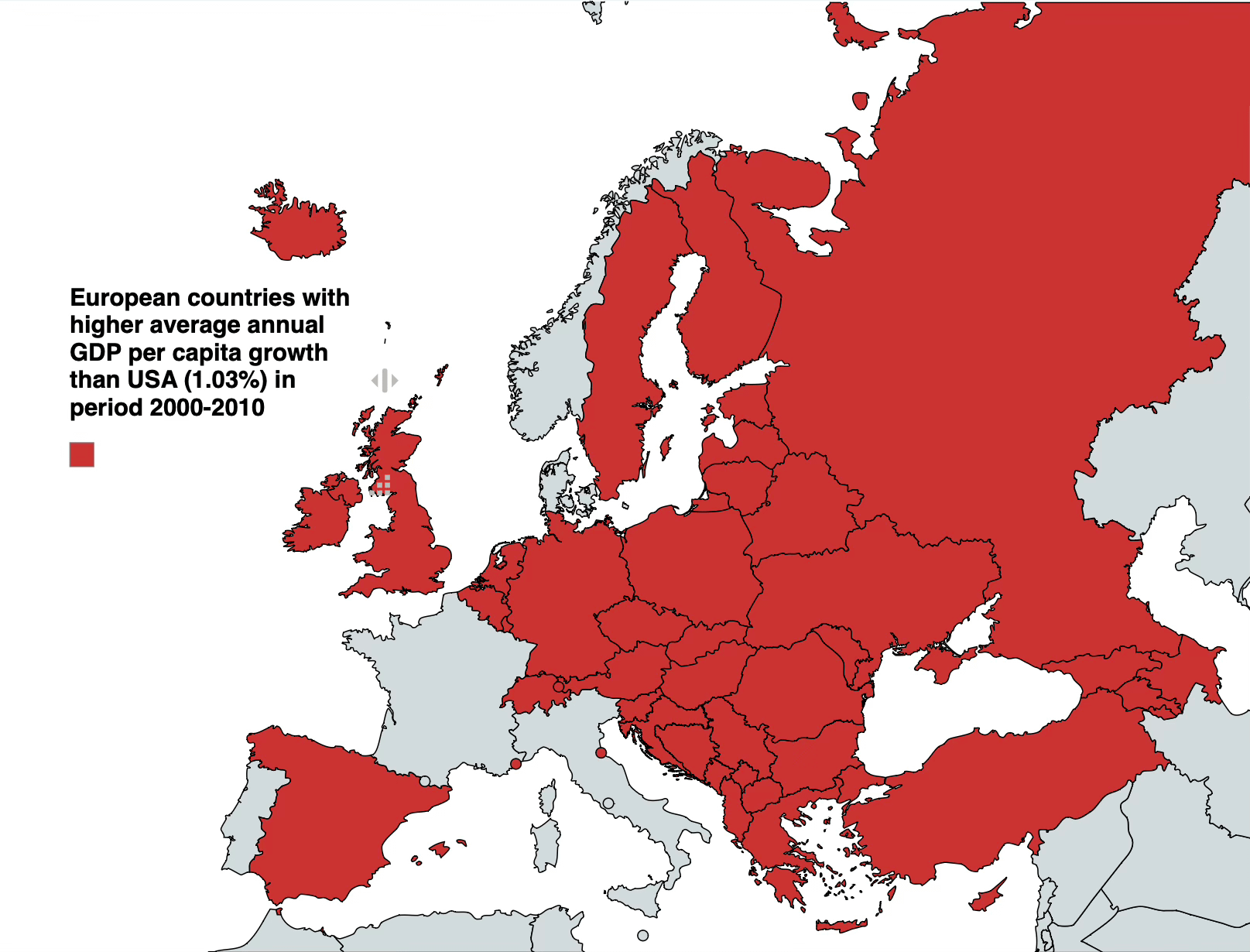
The 2000s would also be the final decade during which the economy of the US and Continental Europe would grow at roughly the same rate. The first years after the introduction of the common currency saw a temporary surge in European economic growth. Though unemployment continued to be significantly above the US level, it continued to plummet across the currency area, reaching a temporary trough in 2007. This development led to a short-lived surge of euphoria, as the Old Continent (or at least parts of it) would be favourably contrasted with the arrogant hegemon led by the Bush administration. Yet this optimism would soon vanish; the collapse of the housing bubble in the United States would eventually damage the European economy much more than it did that of the country in which it had originated. The system had clearly failed, and in an attempt to find a replacement, the US and Europe would increasingly become aware of how unsustainable their partnership had become.
Continued in Part V