
Coming Apart (Part I)
The Transatlantic Rift and the Divergent Social Structure of the US and Europe

One of the recurring subject matters of this publication is the deteriorating relationship between Europe and the United States. Transatlanticism defined the 20th century, with the alliance between the Old World and the New seeing a Golden Age in its second half. Yet in recent years this relationship has become incredibly strained, increasingly resembling a failing marriage more than a functioning international alliance. I have already repeatedly written on this phenomenon, from a perspective of both ideology and international geopolitics, but now I want to add another dimension, that of economic and social structure. The divergent paths the two continents have taken in terms of economic and social structure can explain much of their current difficulties in maintaining their alliance. For the past half century, these two societies were either similar or complementary, but increasingly their respective social structures mean that they have nothing in common and little incentive to stick together.
The Roots of Convergence
The post-war era, often regarded as the heyday of Transatlanticism, saw the United States and Europe temporarily converge in terms of how their respective societies were structured. This convergence followed nearly two centuries of relatively independent development. During this period, contrary to the present experience, Western Europe was in fact more socially and economically unequal than the United States. The combination of aristocratic heritage and the early onset of industrial capitalism meant that vast private fortunes accumulated more quickly in Europe than the US, a gap which was not fully closed even as US capitalists followed suit in the Gilded Age. This more rigid social structure in Europe also meant that labour agitation gained traction more quickly on the Old Continent. The Socialist movement first developed in Western Europe, first becoming capable of significantly influencing policy in Bismarck’s Social Reforms. These reforms laid the groundwork for the conservative welfare state, a setup which sought to tie various classes to the state through the selective granting of demands made by Socialists and Social Democrats. These measures soon spread throughout Central and Northern Europe, expanding into Austria and parts of the Nordic countries. Despite the novelty of these measures, they did not make any statistically notable dent in inequality in Europe, as the continent remained dominated by established and entrenched economic and political elites.
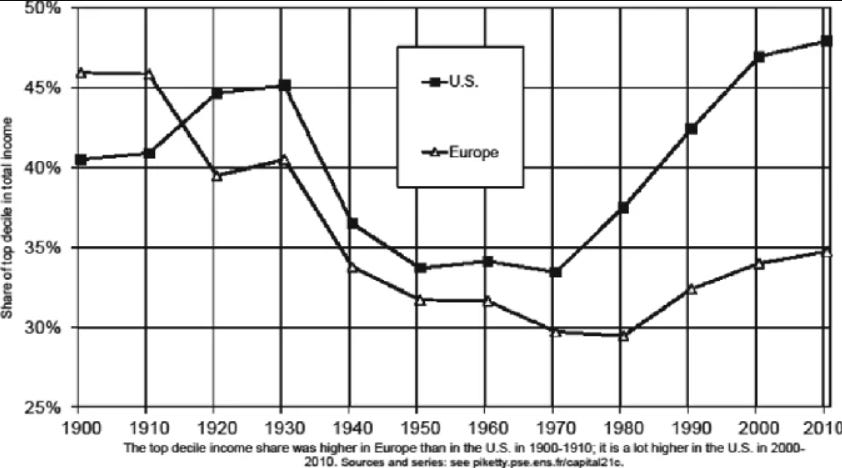
Things began to change, however, as the great catastrophes of the early 20th century destroyed much of the economic basis for this established elite. The First World War disrupted the international economy, as four large European empires collapsed, the Ottoman, Russian, Austro-Hungarian, and German monarchies failing to survive the massive conflict. This political collapse destroyed a significant amount of the economic system, the share of wealth held by the elite collapsing with them. For the first time in history, this meant that Europe was less economically unequal than the US; the share of national income going to the highest decile had begun to drop on the Old Continent while it continued to increase in the US. Yet soon thereafter this trend also came to an end in the US. The Great Depression tanked stock market valuations, destroying the wealth and income of America’s elite in the process. The crisis led to one of the most dramatic shifts in American governance in the country’s history, the introduction of the New Deal. This programme created a welfare state comparable to the one created by Bismarck’s reforms in a country which had previously seen only minimal involvement by the federal government in the economy. Along with an expanded welfare state, the federal government also became integrally involved in economic management, seeking to remedy the imbalances the market seemed to create on its own. Central to this shift was the intellectual groundwork laid by British economist John Maynard Keynes, who argued against the notion of the market being inherently self-correcting. Rather, severe downturns required government stimulus to return the economy to growth, interventionist policy thus justified by economic theory.
This experiment managed to steer the US out of the Depression relatively quickly, the country finally recovering by the time the Second World War started. That conflict destroyed what was left of the preceding European economic order, laying the groundwork for a new chapter in Transatlantic history. The Soviet occupation of Eastern Europe soon raised fears of Communist domination of the entire continent in both Washington and the major Western European capitals. This meant that the societies on either side of the Atlantic Ocean had to learn to work together. In the following decades, the Transatlantic alliance became the core axis around which Western civilisation was organised. This functioned in part because the two sides were structurally quite similar during this era. Both were nominally capitalist while nevertheless retaining strong welfare states and government intervention in the economy. Equally important was that both represented developed industrial economies, based around a Fordist model of production and powerful and influential labour unions. This period of convergence produced what is regarded by many as the “Golden Age of capitalism”, as economic growth coincided with broad economic equality and the development of an industrial middle class. This middle class formed the backbone of both societies, the unique political compromise defining the era retaining worker support for the capitalist system. Some differences continued to exist; in the US the left of the political spectrum continued to be dominated by the Democratic Party, which remained defined by American liberalism, while in Europe Socialism and Social Democracy were more common. Furthermore, even when the welfare state was at its height, the US never saw the establishment of a universal public healthcare system (programmes such as Medicare and Medicaid only available to the poor and elderly respectively). Yet these minor differences occurred at a time when both societies could broadly be grouped as exhibiting a form of “managed capitalism”.
The Parting of the Ways
This system began to collapse everywhere, however, as the crisis of the late 1960s and early 1970s drove up inflation and collapsed faith in the established system. The spurt of inflation had primarily been caused by the oil embargo enforced by the Arab states on the collective West due to its support of Israel in the Yom Kippur War. The sustained inflation proved so destructive to the previous system because it coincided with sustained labour market weakness. This “stagflation” was believed to be impossible in Keynesian orthodoxy, which held that governments could simply choose between inflation and unemployment. The crisis produced distinct results across the developed world, as countries were not all affected to a similar degree. The Germanic and Nordic countries came through the crisis with their economic base relatively intact, while the Anglosphere and Italy were exceptionally negatively affected. This divergent experience profoundly shaped what was viewed as a solution to the crisis. In the Germanic countries, tweaks to the existing system were seen as sufficient, while in the Anglosphere a demand for a radical break with the established status quo began to develop.
This demand most notably expressed itself on the right of the political spectrum, with a new breed of Anglosphere Conservative offering a completely distinct vision of economic governance. This new “neoliberal” movement rejected the Keynesian principles of interventionist economic governance in their entirety. Rather than being a stabilising force in the economy, the state was now believed to be the cause of the recent economic turmoil. The surge in government spending was believed to be an equally important cause of price increases as the oil embargo. The only way to return the Anglosphere to sustainable growth and price stability was by curtailing the growth of the money supply which had occurred to finance government deficits. Thus, from 1979 onward, leaders such as Ronald Reagan and Margaret Thatcher oversaw a drastic increase in interest rates, believed necessary to finally attain renewed price stability. This occurred in two distinct ways in the US and Britain; Thatcher combined the interest rate rise and slowing of the growth of the money supply with a programme of austerity, while Reagan continued to oversee massive deficits. Yet both represented a massive shift in economic governance, as future growth was located in the private sector. Government influence was massively curtailed and taxes drastically cut. These reductions in taxation primarily affected the rich, as tax progressivity was massively reduced and the welfare state became significantly less generous. But the revolution in economic affairs did not just occur in distributional questions; the structure of economic production itself was shifting. Both Reagan and Thatcher relentlessly embraced deindustrialisation and the move towards a service-based economy. To achieve this transformation, the power of industrial labour unions had to be broken, which was achieved by the crushing of a number of strikes in the mid-1980s. From this point onward, highly educated white-collar work would capture ever more of the economic value created in the Anglosphere, as an entirely different class system developed.
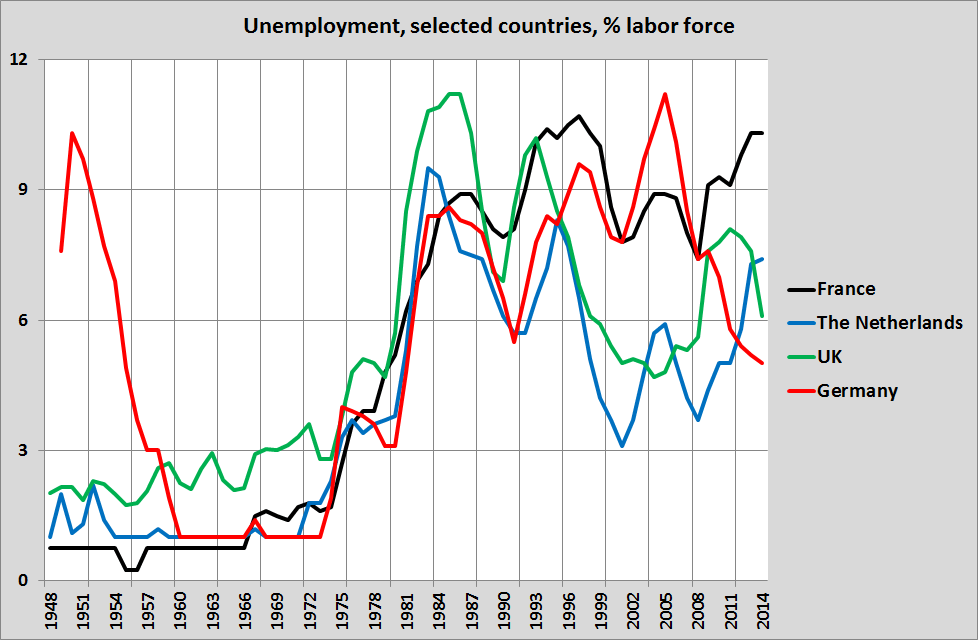
The distinct experiences which Continental European countries had during the crisis of the 1970s meant that political incentives were quite distinct on the continent. In the Germanic countries the desire for a radical break with the established system was much less severe than in the Anglosphere. France, meanwhile, shared the desire for a break with the status quo which had animated Reagan’s and Thatcher’s rise to power, but this desire expressed itself in a completely distinct way. Rather than an embrace of “neoliberal” reforms, French voters bet on newly elected Socialist President François Mitterrand accomplishing a “break with capitalism”. The contrast with Reagan and Thatcher was not quite as pronounced in Germany, which would be governed by Conservative Chancellor Helmut Kohl from 1982 onward, but no less consequential. For while Reagan and Thatcher had created a new kind of Conservatism based on crusading zeal in favour of the free market, Kohl remained attached to a much more consensus-oriented traditional Conservatism. The differences in political persuasions between Anglosphere and Continental European leaders during this period would mark the end of the period of convergence between the two sides of the Atlantic. From this point onward, the Old World and the New would venture on different paths, eventually leading to the profound estrangement so prevalent today.
Continued in Part II